


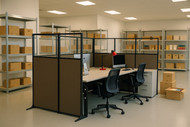
Quiet Workspace Guide: Where to Find the Best Acoustic Office Cubicles
Posted by Kate Murphy on Aug 12th 2026
You can usually tell when an office is too distracting without measuring a single decibel. Employees reach for headphones, take laptops into empty meeting rooms, or lose their train of thought when another conversation starts nearby. These small workarounds often point to a larger problem: the space does not provide enough separation for focused work.
Instead of asking employees to keep working around the problem, you can make the workspace work better for them. Acoustic office cubicles add visual separation and sound-absorbing surfaces around individual desks, helping employees focus without requiring permanent walls or fully enclosed offices.
Acoustic cubicles will not make a workstation completely soundproof. Conversations may still be audible, especially in a busy office. The purpose is to make nearby voices and everyday activity less distracting—not eliminate every sound.
If you are wondering where to find the best acoustic office cubicles, consider your privacy needs, main noise sources, and how often the layout changes. Here is what to look for—and which Versare solutions may fit your office.
Why Acoustic Office Cubicles Create Quieter Workspaces
Nearby conversations, ringing phones, and constant movement can all interrupt focus. Acoustic cubicles address both sound and visual activity by adding sound-absorbing surfaces and clear boundaries between workstations.
Reducing Conversations & Workplace Distractions
Nearby conversations can be difficult to tune out, even when we are not part of them. Research on the “irrelevant speech effect” shows that background speech can disrupt verbal short-term memory even when people try to ignore it.
Acoustic panels absorb reflected sound, making phone calls, discussions, and routine office noise less prominent. When placed between workstations, they help keep one employee’s conversation from dominating nearby desks, creating a more comfortable environment for focused work.
Improving Focus Without Isolating Employees
Employees often need collaboration and concentration during the same day. Fully enclosed offices provide separation but can make quick communication less convenient. A completely open layout keeps everyone connected but may offer too little privacy for focused work.
Acoustic cubicles create defined work areas that support concentration while keeping coworkers close enough for quick questions and collaboration. For example, a marketing team can use individual cubicles for writing and reporting, then gather in a shared area when it is time to brainstorm.
Adding Visual Privacy Alongside Acoustic Benefits
Cubicle partitions also limit distracting movement within an employee’s line of sight. Taller panels or sliding doors provide more visual separation, while lower or window panels preserve visibility and make communication easier.
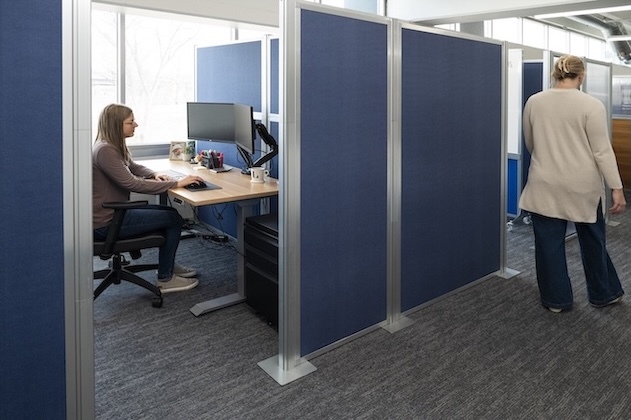
Because modular partitions do not require permanent construction, offices can adjust the level of privacy as teams and layouts change.
What to Look for in the Best Acoustic Office Cubicles
The right cubicle is not simply the tallest or most enclosed option. It should fit your employees' work, the room itself, and your long-term plans for the space.
Sound-Absorbing Materials
Look for fabric-covered panels made with an acoustic or sound-dampening core. These materials absorb some reflected sound instead of sending all of it back into the room.
You may also see a Noise Reduction Coefficient, or NRC, in the product specifications. NRC is typically measured on a scale from 0 to 1.0, with higher ratings indicating greater sound absorption. However, an NRC rating does not mean a product is soundproof. Panel placement, height, surface area, room finishes, and the location of the noise source all influence the final result.
Flexible Office Configurations
Teams grow, hybrid schedules change, and departments move. Modular cubicles can adapt without requiring an entirely new workstation system.
Look for panels and posts that can be assembled, taken apart, and rearranged. Also check whether compatible components can be added later. “Portable” and “configurable” do not always mean the same thing, so review how each system connects before purchasing.
Workspace Privacy
Choose panel height and layout based on how employees work. Focus-heavy roles may need more separation, while collaborative teams may benefit from greater visibility.
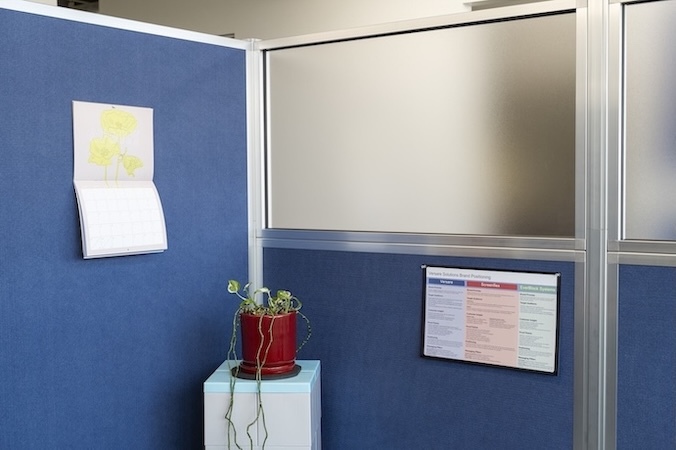
U-shaped cubicles provide privacy on three sides, while H- and W-shaped layouts separate multiple workstations. Lower or windowed panels preserve visibility; taller solid panels provide more privacy.
Quality, Durability, & Design
Choose products made for everyday commercial use. Review the frame, core, connection hardware, support feet, surface materials, and warranty. If the office will be reconfigured frequently, pay special attention to assembly and connector durability.
Color and finish matter, too. Neutral fabrics can blend with an existing interior, while brand-aligned or bright colors can help define departments or energize a larger space.
The Best Acoustic Solutions for Office Cubicles
Now that you know what to look for, let's explore where to find the best acoustic office cubicles for different workplace needs. These Versare products offer varying levels of privacy, portability, and flexibility.
Individual Cubicles for Focused Work
A U-shaped cubicle creates a defined individual workstation with privacy on three sides, making it useful for accounting, writing, scheduling, customer support, and other concentration-heavy roles. Its two-inch-thick, tackable panels feature a sound-dampening honeycomb core, while the tool-free, slide-together design simplifies assembly. Optional window panels add visibility while the surrounding panels help soften sound and visual distractions.
Preconfigured Cubicles for Small Teams
Preconfigured H- or W-shaped cubicles simplify planning for departments and small teams by grouping multiple workstations into an established layout. Like the U-shaped version, these kits also feature two-inch-thick, sound-dampening panels and a tool-free setup. The H-shape separates back-to-back employees, while the W-shape organizes adjacent stations. Fabric colors, frame finishes, window panels, and an optional electric channel allow the system to be tailored to the office.
Temporary Cubicles for Hybrid or Project-Based Work
Hybrid offices, training rooms, and short-term project areas may need privacy that can be repositioned as schedules or activities change. Workstation Screens are lightweight partitions available in single-, two-, or three-panel configurations, with optional windows. A 360-degree hinge allows connected panels to be arranged in different shapes around existing desks.
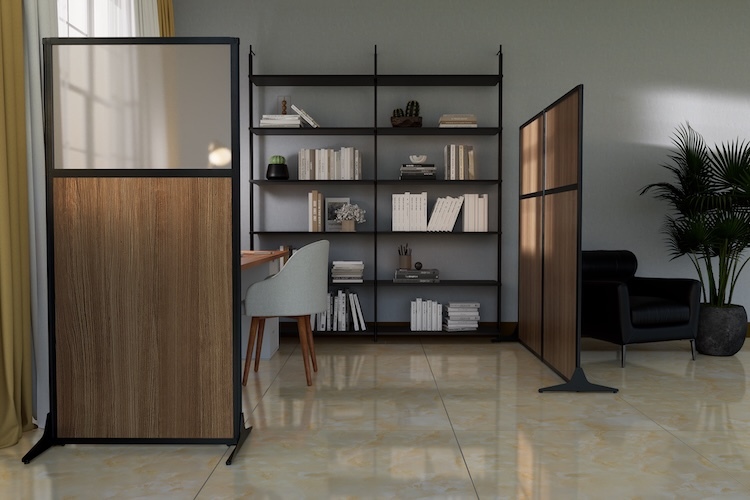
One planning note: the screens hinge together only in the configuration purchased and cannot be linked into a larger continuous system. If future expansion is a priority, choose a fully configurable system instead.
Custom Office Layouts That Grow with Your Team
For unusual floor plans or workplaces that expect frequent change, configurable cubicles offer greater control. Hush Panel Configurable Cubicles let you combine sound-dampening panels, posts, and optional window inserts to create individual workstations, privacy dividers, or collaborative areas.
Compatible components can be rearranged into new layouts as teams grow, offices move, or hybrid schedules change. Rather than replacing the entire system, you can rework the existing panels and add components where needed—making configurable cubicles a practical long-term investment.
Choosing the Right Acoustic Cubicle for Your Office
Start with three questions: What sounds are most distracting? How much privacy do employees need? How often will the layout change? Your answers will help narrow the options.
For Open Offices
Use modular cubicle systems to reduce distractions while keeping communication convenient. Place panels between employees who are likely to distract one another, such as frequent callers and coworkers who perform detailed, focus-heavy work.
You can also organize work zones by activity. A customer service team might use an H- or W-shaped layout near its supervisor, while analysts use individual U-shaped cubicles in a quieter part of the office.
For Hybrid and Flexible Workspaces
Choose movable privacy screens when quick repositioning is the main priority. Choose modular cubicles when you need established workstations that can be disassembled and rearranged over time.
The two can also work together. Cubicles may form the main workstation area, while portable acoustic partitions provide temporary separation near shared desks, project tables, or video-call areas.
For High-Distraction Environments
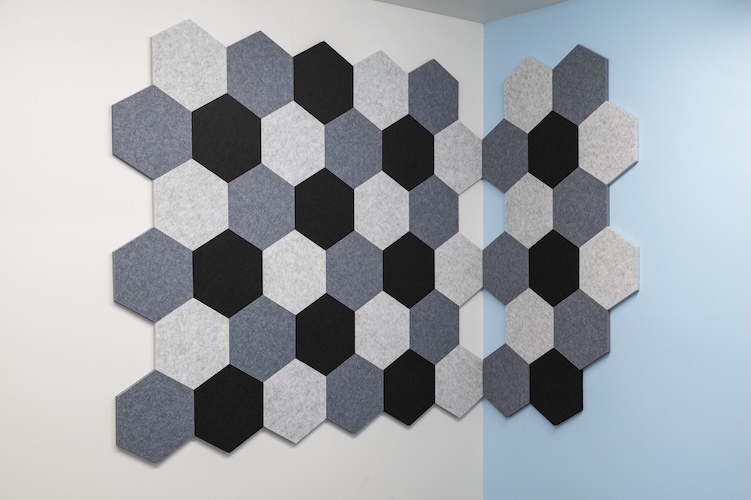
Cubicles manage sound around individual workstations, but a large, reflective room may need a layered approach. Pair acoustic cubicles with freestanding partitions between departments or wall-mounted panels on large, bare surfaces. Moving printers, break areas, and informal meeting zones away from focus stations can also help.
Create a More Productive Workspace with Acoustic Office Cubicles
The best acoustic office cubicles combine sound absorption, visual privacy, and a layout that can adapt to the organization. They help reduce echo and soften nearby distractions while giving employees a defined place to focus without constructing permanent offices.
Remember, acoustic cubicles reduce noise; they do not completely soundproof a workstation. Pairing them with freestanding or wall-mounted acoustic panels can provide additional sound control in especially busy or reflective spaces.
Wondering where to find the best acoustic office cubicles? Explore acoustic cubicles and workstations or other commercial office solutions to find the right fit for your team, floor plan, and privacy needs.